Thursday, 29 December 2016

Mid-Term Review Meeting in Dublin, Ireland


Hi guys!!

How have you been during this month? Hopefully, all of you had a wonderful Christmas and spent some quality time with your family and friends.


As we get closer to the end of 2016, I take advantage to write here about an important meeting that our TRUSS research group had at the beginning of this month, on the 1st and 2nd of December in Dublin, Ireland.

I'm talking about the Mid-Term Review (MTR) meeting that had the goal of bringing together all the ESR's, supervisors, representatives of partner organizations and project coordinator with a project officer from the Research Executive Agency (REA) and a scientific external expert. This MTR had the goal of assessing the fulfillment of the scientific, training, management and networking aspects that are part of the grant agreement that serves as the basis of this current European research project. Hence, not only the scientific progress was to be evaluated but also particular attention was to be given to the training activities and networking aspects including the topic of each ESR's secondment.
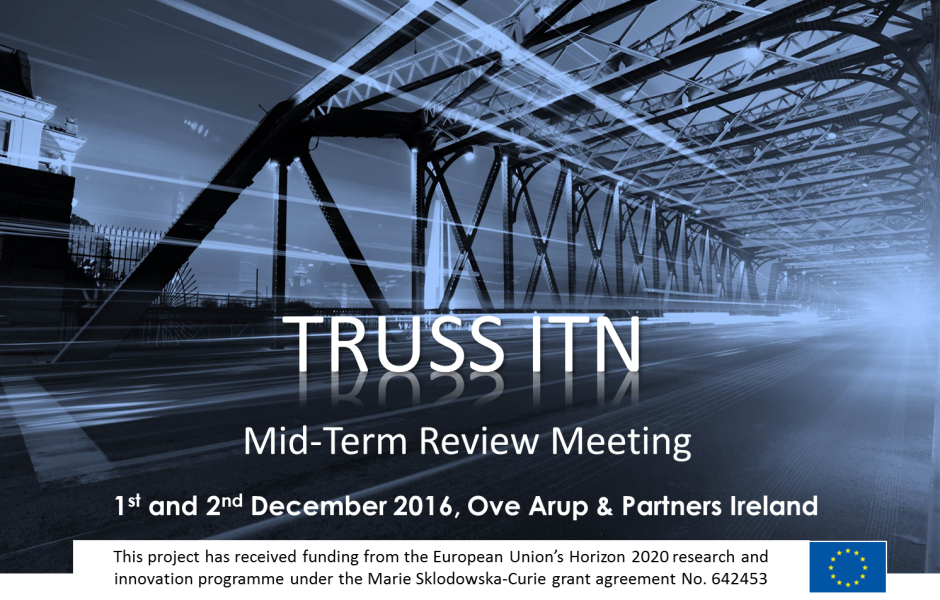
(Credits)

This meeting was held in the offices of Ove Arup and Partners, one of the global leading firms of structural design engineering.

Ove Arup & Partners offices in Dublin, Ireland (credits)

After an initial introduction of all the attendees,  the Project Coordinator, Prof. Arturo Gonzalez made an interesting presentation about the TRUSS project and its current situation. From this, I want to point out the information provided regarding the local training on complimentary skills received by the ESRs: "314 hours in 8 language courses, more than 110 hours in teaching activities -supervising, demonstrating or providing tutorials- and more than 150 hours in other taught courses on soft skills -bibliographical management, how to write an academic paper, communication skills, etc-." Furthermore, regarding more technical skills, the ESR's received "more than 500 hours in 19 laboratory/field tests and almost 1000 hours in 71 courses directly related to their research while also attending 37 conferences"

Moreover, details with reference to the already carried out dissemination of the overall project were shared with all the attendees of this meeting: "TRUSS has published 24 technical papers (3 in peer-reviewed journals and 21 in conferences), and 3 press releases in mainstream magazines or newspapers prior to November 2016".

Finally, each ESR made a very brief and small presentation regarding their scientific progress, local and network-wide received training in these past 14 months.

Presenting at Mid-Term Review Meeting in Dublin, Ireland (credits)
In conclusion, this was an incredibly enjoyable meeting where it was possible to observe the general good situation of the project and the great work being carried out not only by each of the ESRs but also by every person involved in this research program.

In addition and on a great final note, I conclude this post by informing you that in little less than 3 weeks our group is going to get together again, this time in Barcelona, for the second network-wide training week. Therefore, in the next post, surely I will write here plenty of enjoyable stories about this meeting, so please stay tuned!

I wish you all a wonderful year of 2017!


Monday, 28 November 2016

Attendance and presentation at IALCCE' 16 in Delft, Netherlands


Hello everyone!

How is everything going with you guys? This month went flying but, at the same time, it was greatly productive. However, in this post, I will talk with you about my experience last month at IALCCE 2016.

The Fifth International Symposium on Life-Cycle Civil Engineering, IALCCE2016, was a conference held in the city of Delft, South Holland in Netherlands from the 16th to the 19th of October 2016.

IALCCE'16 logo (credits)
This was a conference organized by Infra Quest, a collaboration between the Delft University of Technology, TNO (the Netherlands Organization for Applied Scientific Research) and Rijkswaterstaat (government agency within the Dutch Ministry of Infrastructure and the Environment. Furthermore, this event was mainly held at TU Delft Aula Congress Centre, that can be seen here.


Venue of IALCCE'16 (credits)
The International Association for Life-Cycle Civil Engineering, or IALCCE, is an organization  that focus on the advocacy of the life-cycle assessment and study in the field of civil engineering through international cooperation for the society benefit. They sponsor this conference that is held every two years, being that the first was held in Varenna, Italy back in 2008.

In this conference, the theme of this year event was: Civil Engineering from a life-cycle perspective. In this way, and taking into account the topic of the project that we have been discussing in this blog, our research group at Barcelona, submitted a document with the title "Health Monitoring of real structures by distributed optical fiber". 

Article (left) and Presentation (right) submitted to IALCCE'16
Here, as the title suggests, it was showcased the opportunities and enhancements that distributed optical fiber sensing can provide for Structural Health Monitoring of real world structures, with important saving costs for the structure's owner authorities (including, naturally, the tax payers) and the further assurance that can be granted to their everyday users.

Waiting to present at IALCCE'16 on the 19th of October 2016
As always, this was also an excellent opportunity to continuously get to know excellent work that is being conducted in areas similar and relevant to the one that I'm dealing with in my project, and also, to get to know the people behind those same studies.

As I'm writing this, the date of TRUSS's Mid-term Review Meeting at Dublin is approaching on the first two days of December. In this way, hopefully, I will be able to give you some information of what went on on this meeting on my next post.

I also, take this opportunity, to wish you all a happy and delightful Christmas. 

See you soon!


Friday, 28 October 2016

Beginning of secondment at COTCA

Hi guys, how's everything?

I hope your work is going well. As for me, a lot of work is being conducted with its inherent challenges but in the end I think everything will come out just fine.

As planned in the beginning of my project, the time to start my secondment at COTCA S.A. has arrived, so basically in this post I will talk with you about this important stage of my project within TRUSS.

This secondment is part of the training that, as an ESR in TRUSS project, we receive during our research that is a period between 3 and 6 months. ESR's that are hosted at universities are seconded to industry and vice versa. There's several benefits that we receive from this experience, such as a better perspective from industry of the topics of our researches and in this way provide us with knowledge that will aid us in our researches in order to provide work and information that will better tackle the real necessities of our current society. Moreover, it's a great way to provide personal experience in an industry wise environment, that for instance, in my personal case, I've never had experienced before, improving our curriculum and widening our future professional opportunities after the conclusion of our work within this ITN.

So, in this way, last September 12th I officially initiated my secondment at the company COTCA S.A. that is also located in the city of Barcelona, Spain. This secondment is done under the supervision of Dr. Sergi Villalba that is an employee of this company and is the overall co-supervisor of my project. 

COTCA S.A. logo
This is a company that was founded in 1979 and that is dedicated to the quality control of construction in civil and building structures. In this way, they have a large expertise in the instrumentation of structures for monitoring purposes with different types of sensors including, and this is very important, the use of distributed optical fiber sensors, more specifically the OBR based sensor that I've mentioned in previous posts. It's a relatively small company, with only 16 staff members but that has significant practical experience on structural monitoring, instrumentation, control and maintenance of structures.

Actually, I had the opportunity of working with Sergi before, as part of some short stays of my secondment back in January and February, when a two-span bridge was being monitored with OBR sensors and where I was able to acquire a lot of practical experience by witnessing in first hand the main adversities and difficulties that arise from the real world application of this technology.

In opposition to what happened with a lot of my fellow ESR's, the location of my secondment is not far away from where I am currently living. Actually it's closer to my home than the university, so in this way, my normal daily routine was not at all affected by this. This also allows me to easily and often visit UPC either to have a meeting with my supervisor, Prof. Joan Ramon Casas, or the laboratories of the Structures' department.

Now, as part of my long stay secondment, among several tasks, I'm analyzing the data collected in the aforementioned real world application as well as other experiments already conducted by me in the UPC laboratory. I'm also trying to thoroughly prepare further laboratory experiments which always provides different challenges such as the coordination with laboratory technicians and availability of loading test machines. Furthermore, it's required to buy and assemble several components in order to successfully prepare these experiments, such as new and different adhesives, concrete ingredients and last but not least, more optical fiber! For this I have to personally contact different commercial entities and carefully evaluate each option. Naturally, this process demands a considerable effort in order to overcome the usual inertia associated with these actions, but in the end, I think it provides me a valuable and unique kind of experience that otherwise I wouldn't be able to acquire.

So, this is basically it for now. Hopefully, next month I will be able to get back to you guys with more and exciting news.

Stay tuned and see you soon!


Wednesday, 28 September 2016

Presentation at 5th Workshop of COST TU1402 in Denmark


Hello, everyone!

How is the return to work have been for you? Hopefully with a lot of new and interesting ideas.


Well, I know that, at least for me, this has been a period with plenty of tasks and activities which sometimes makes it difficult to deal with each one at a time. Nonetheless, I hope that in the end, everything will come out nicely with productive results for my project. Surely I will speak about this with more detail in future posts.

In this post, I will talk about my experience, on the 5th Workshop of COST action TU 1402. For those of you that don't remember, back in my last April post, I mentioned that a workshop of this specific COST action had been held here at UPC in Barcelona back in March. Like I mentioned at that time, it had been very interesting to attend that workshop and I was looking forward to have the opportunity to attend or even participate in new meetings of this action. It so turns out that this opportunity indeed appeared  back in June when my supervisor received a call for presentations on the experience of the use of new structural health monitoring techniques to be made at the 5th Workshop to be held at the Technical University of Denmark in Kongens Lingby.

This event was held last month on the 24th and 25th of August. Here, we decided to present a review of the experience of our local research group at BarcelonaTech on the use of Distributed Optical Fiber Sensors (DOFS) in both laboratory and real-world applications. Thus, the title of our presentation was: "Concrete structures monitoring with Optical Backscatter Reflectometry based Distributed Optical Fiber Sensors". Here, you can see a photo taken during my presentation.

Presenting at 5th Workshop of COST TU1402

Since the title of this action is "Quantifying the Value of Structural Health Monitoring" the presentation was more focused on the added information and accuracy obtained by the use of this sensing technique on SHM applications. Furthermore, as in the last meeting, I got to meet several researchers working on incredibly interesting topics, even ones working on researches very similar to mine, allowing for fascinating and amusing conversations between presentations. You can see my presentation as well as any other made in this event here.


As always, this experience allowed the continuous learning of the most recent investigated topics in the SHM field as well as the prolific exchange of ideas and opinions regarding my own project which I believe can only improve the final quality of my work.

Group photo of 5th Workshop of COST TU1402 at TU Denmark

Furthermore, I take the opportunity to announce that I officially began my secondment at COTCA S.A. company as it was planned at the beginning of my project. In the next post, I will talk in more detail about this topic and its role in my research within the TRUSS group.

Stay tuned for more posts in the near future!

See you soon!


Saturday, 27 August 2016

Attendance of the 8th European Workshop on Structural Health Monitoring


Hey guys!

Enjoying some of your vacation days? For me, I'm afraid they are coming to an end so it's time to get back to work with recharged batteries. But before, and like I said in my last post, I will tell you guys very briefly about my attendance of the 8th European Workshop on Structural Health Monitoring (EWSHM2016).


This was an event held at the Euskalduna Conference Center in the beautiful city of Bilbao, in the Basque country in Spain, from July 5-8, where the latest advances related with Structural Health Monitoring (SHM) were presented. At the same time, the 3th European Conference of the Prognostics and Health Management Society (PHME16) was organised jointly at the same building. As me, also my colleague JJ Moughty (ESR12) presented part of his work on EWSHM2016 and my colleague Matteo Vagnoli (ESR9) on PHME16.

Me with my colleagues JJ Moughty (ESR12) and Matteo Vagnoli (ESR9) at Bilbao

I made a presentation regarding my work on the literature review that I conducted in the first year of my research with the title: " Review of civil engineering applications with distributed optical fiber sensors".

Presenting at EWSHM2016

As always it was very pleasant and interesting to attend this event where I was able to meet and interact with new people and get to know more about the current researched topics related with Structural Health Monitoring and other relevant themes.

I wish you guys a good and energetic return to work.

Stay tuned for more developments regarding my project.

Wednesday, 20 July 2016

Attendance of IABMAS 2016 at Foz do Iguaçu, Brazil

Hello everyone!

How have you been doing in this lovely summer? I hope to find you well.

Like I mentioned in my last message, in this post I will talk about my trip to Brazil for the attendance of the 8th International Conference on Bridge Maintenance, Safety and Management. 

This conference was held in Foz do Iguaçu, Brazil, from June 26-30 and organized by the International Association for Bridge Maintenance and Safety (IABMAS). This is one of the biggest bridge monitoring conferences in the world and is organized every two years being that the first was held precisely here in Barcelona in 2002.

Like the title of the conference suggests, its main objective is to bring together academics and practicing professionals related to bridge maintenance, safety, and management for the dissemination of the latest developments in this field. 

The city of Foz do Iguaçu, located in the southwest interior of Brazil (at the border with both Paraguay and Argentina) is characterized for being the place where the Paraná and Iguaçu river converge. Near to the meeting of this two rivers the Iguaçu Falls are located, listed as one of the New 7 Wonders of Nature, with a flow of up to 45 milion liters per second! And as you can see from the following picture, it's astonishing beautiful. 

Overall perspective of Iguaçu Falls (credits)
A very happy ESR in front of the falls

In this event I presented a paper developed under the TRUSS project with the title: "Monitoring of shear cracking in partially prestressed concrete beams by distributed optical fiber sensors".


Presenting at IABMAS 2016
This was an extremely enticing and productive conference where I got to interact and discuss with several researchers from all around the world about several advances and topics of studies related with the structural monitoring of bridges. The next IABMAS conference is going to be in Melbourne, Australia in July 2018 and the deadline for the submission of the abstracts is May 2017. Hopefully, I will be able to attend it with further developments of my project together with more of my ESR colleagues.  


Next month, I will talk about another conference that I attended in the beginning of this month at Bilbao, so please stay tuned.

In the meantime, I'll leave you with this incredibly beautiful image of the new  European champions!!


Friday, 1 July 2016

TRUSS annual plenary meeting at Santander

Hello everyone!

How is the beginning of the summer been treating you? I hope you all have been enjoying it.

As for me, like I said in my last post, this has been a busy but also productive period of my project. In addition, to the work that I've been developing at the UPC laboratory (which I intend to talk about in a future post), I've been attending different meetings and conferences, which gives me plenty to talk about here. In this way, I will speak about these different events in different posts in this blog, starting by describing to you the 2nd meeting of our TRUSS ITN research group.

This meeting took place at Santander, Spain on the 16th and 17th of June. For those of you who don't know this city, Santander is the capital of the autonomous community region of Cantabria located in the north of Spain. Here you can see a few pictures of it (all of them were downloaded from the website of Santander tourism department).


In this meeting, all the ESRs presented their progress on there respective projects followed by separate meetings of each ESR with a small group of experts, by the name of doctoral studies panel (DSP) meetings, which provided feedback on the personal career development plan (PCPD) of each ESR.


Furthermore, we were presented by the local organization with different and interesting networking activities. From a visit to a factory of nuclear plant components, to boat rides through the Santander bay and also a visit to a historical  village in this region.


This was a incredibly fun and enjoyable meeting where it was good to see the development of all my colleagues and engage in these activities with them. I must refer that unfortunately, our colleague ESR 13 Federico Perrotta was not able to attend this meeting and in this way, he was greatly missed by all of us. But as you can see from his blog his project is going just fine.

Currently, I'm writing this post from Foz do Iguaçu in the beautiful country of Brazil, where I'm attending IABMAS 2016 conference and where I presented an article related with my PhD project. Here you can see a small preview of my time here in Brazil, which I will talk about in my next post.


Stay tuned for further developments of my work and if you want to know more of the meetings and conferences that I'm attending!